
Washington County Criminal Court Cases
Washington County belongs to New York's Fourth Judicial District. Washington County Court is the normal superior criminal forum for felonies prosecuted in the county. A felony may start with an arraignment or preliminary proceeding in a town or village justice court, then move to County Court after an indictment or superior court information. New York Supreme Court has broad trial jurisdiction, but County Court is the main local felony court.
Town and village justice courts play a separate role. They hear misdemeanors and violations within their areas and hold early felony proceedings. This means the place of arrest does not always identify the final file holder. A local justice court may hold the complaint and arraignment entries, while Washington County Court holds the later indictment, motions, plea, judgment, and sentence. Search both levels when the record trail crosses them.
Washington County Court at 383 Broadway
The main local court counter is at the Washington County Municipal Center, 383 Broadway, Fort Edward, NY 12828. The published Supreme and County Court line is 518-480-6920. Call that number when the originating court is unclear or when an online result needs to be checked against the clerk's file. The County Clerk in Building A also maintains Supreme and County Court records and publishes 518-746-2170.
The official New York Courts criminal-records overview shows how court files differ from statewide rap sheets and search reports.
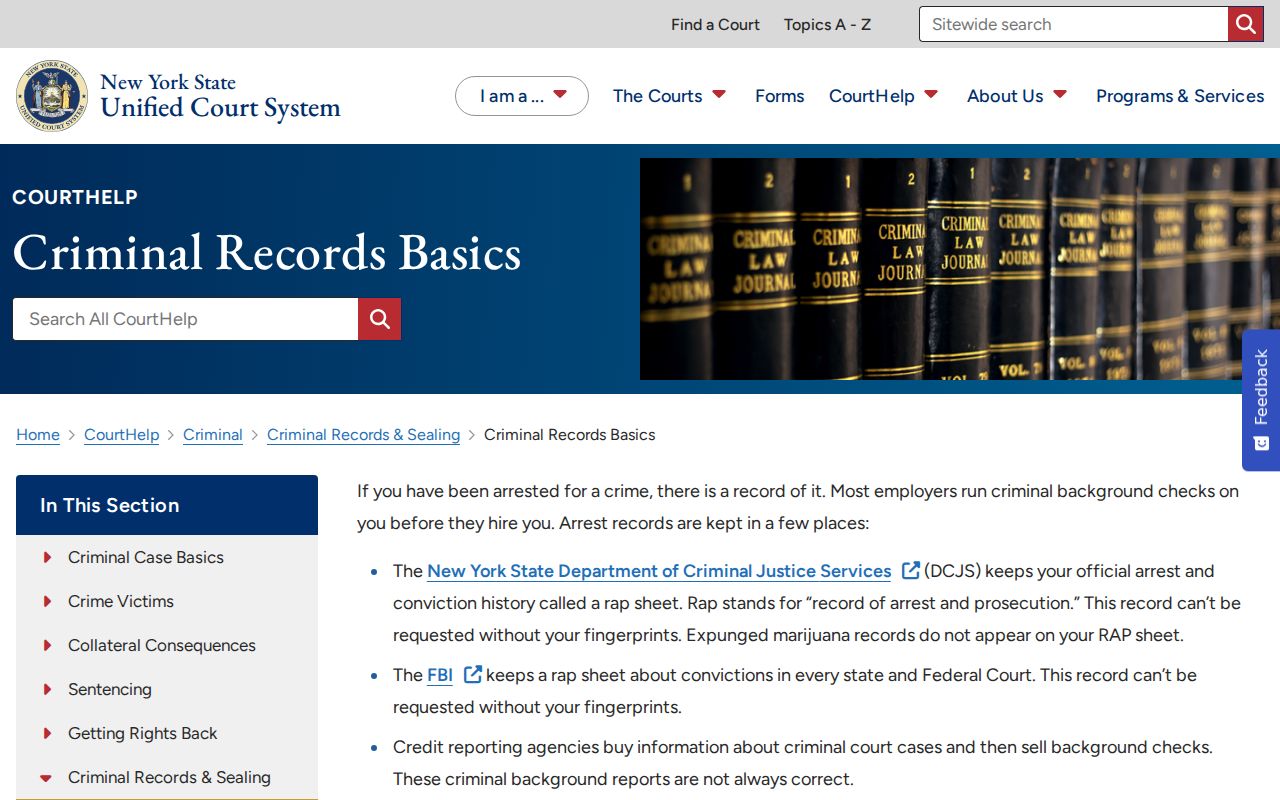
The screen is a useful starting point, but the issuing clerk remains the source for filed papers and a certified outcome. Public parking is on site or nearby, the main entrance is at ground level, and elevators serve the public floors. The Fourth Judicial District accessibility contact is 518-285-5099, and requests for an accommodation should be made a few days before an appearance.
Searching Washington County Case Records
Start with the most exact detail available. The official WebCriminal interface supports defendant, case identifier, and court-calendar routes. Name searches work best with the legal spelling. A case number points to a specific matter, while a court and date can locate a scheduled calendar. Washington County coverage is not uniform across every local justice court, so the clerk fallback is part of the search rather than a last resort.
- Identify the arrest location and likely town or village justice court.
- Search WebCriminal by defendant name or exact case number.
- Use Washington County and the correct court as filters when offered.
- Read the docket for status, appearances, charges, and disposition entries.
- Contact the court that entered the outcome for copies or a Certificate of Disposition.
| WebCriminal field | Type | Required | How to use it |
|---|---|---|---|
| Search mode | Tab or radio | Yes | Choose Defendant, Case Identifier, or Court Calendar |
| Defendant last name | Text | For name search | Enter the legal spelling |
| Defendant first name | Text | For name search | Use it to narrow common-name results |
| County | Dropdown | Optional filter | Select Washington when available |
| Case number | Text | For case search | An exact identifier is the most precise route |
| Court and date | Dropdown and date | For calendar search | Shows published current or future calendars |
When a result appears, record the court name and case number before leaving the screen. Those details help the clerk find the correct Washington County file and reduce the risk of confusing people who share a name. If the search still fails, move to the issuing-court checks described next.
Washington County Case Search Gaps
A blank online result does not prove that no Washington County criminal case exists. WebCriminal coverage varies by court. Older records and some town or village matters may not appear. First confirm the spelling, search mode, and case number. Next, call the local justice court tied to the arrest site. If the matter may have become a felony prosecution, call Washington County Court at 518-480-6920 and ask whether an indictment or superior court information exists.
For much older transferred files, the Washington County Archives is a researched fallback, not a universal court search. It is in the basement of Building A at 383 Broadway. The archive publishes a $20 nonrefundable mail-search charge and $1.30 per-page copy rate. Call 518-746-2136 first to confirm custody and provide the court, name, and likely period.
Note: A missing online entry may reflect court coverage, transfer, redaction, or lawful sealing, so confirm the reason with the proper clerk.
Inside a Washington County Case File
A court file follows a prosecution, not a booking. Its header can identify the court, docket or indictment number, parties, filing or arrest date, charge text, statute sections, case status, counsel, and next appearance. Filed papers may include the complaint, indictment, superior court information, motions, orders, plea record, verdict, and sentencing material. Financial entries may show bail, fines, surcharges, restitution, or payment status when those fields apply.
| Case number and court | Identifies the proceeding and the court that controls the file |
|---|---|
| Charging document | Shows the complaint, indictment, information, or other filed accusation |
| Docket entries | Lists appearances, motions, orders, adjournments, pleas, and trial events |
| Hearing dates | Shows past entries and scheduled appearances when public |
| Disposition and judgment | Records dismissal, acquittal, plea, verdict, or other final result |
| Sentence and conditions | May state jail, prison, probation, fine, restitution, surcharge, or other terms |
Do not read a charge line as an outcome. Charges can change after prosecutor review, grand-jury action, motion practice, or a plea. The disposition is the field that states how a charge ended. A Certificate of Disposition is the concise, court-sealed proof of the charge, conviction, conviction date, and sentence.
Washington County Case Records: CHRS or Certificate
The OCA Criminal History Record Search and a Certificate of Disposition answer different questions. CHRS is a statewide public search of reported open or pending cases and convictions. It costs $95 for each exact full-name and date-of-birth combination. Each alias or different birth date is another search. Direct Access runs around the clock; no-result requests can return at once, while record hits are reviewed and generally emailed the next business day during weekday business hours.
CHRS is not certified. It omits sealed and other non-disclosable cases, and town or village reporting may be incomplete. Use it to cast a broad statewide net. Then request the certificate from the court that entered the result when authoritative proof of a Washington County disposition is needed. Mail is also available through the CHRS Unit at 25 Beaver Street, Room 940, New York, NY 10004, but there is no walk-in CHRS service at that address.
Reading a Washington County Docket
Docket terms show where the case stands. They should be read in sequence, since one entry can revise an earlier event. New York records use their own labels. Terms common in other states, such as deferred adjudication, should not be forced onto a Washington County case. Look for the filed instrument, appearance history, charge-level result, judgment, and sentence.
- Accusatory instrument
- The complaint, information, indictment, or other authorized paper that starts or supports the case.
- Arraignment
- The appearance where charges are stated and the court addresses plea, counsel, and release terms.
- Disposition
- The current or final outcome of a charge, such as conviction, dismissal, or acquittal.
- Superior court information
- A felony charging instrument filed after a valid waiver of indictment.
- Sealing
- A legal restriction on public access while authorized agencies may retain access.
Pending means the matter lacks a final disposition. Disposed means an outcome has been entered, but the actual result still needs to be read. A youthful-offender adjudication is confidential and noncriminal. Grand-jury material is secret, and protected victim data does not become public just because related docket entries can be viewed.
How a Criminal Case Moves
A Washington County felony may cross court lines as it develops. Police allegations do not freeze the final charge. A prosecutor may file a different count, a grand jury may vote an indictment, and later motion or plea work may change the case again. Misdemeanors and violations can remain in the local justice court. The docket should therefore be read as a timeline, not as a single charge snapshot.
Case flow: Charges Filed › Arraignment › Pretrial › Plea or Trial › Disposition › Sentencing
The clerk's file records each court step. DCJS receives a different data stream that links fingerprint-supported arrest cycles to reported court outcomes. Reporting lag or mismatched identifiers can leave a gap in a personal rap sheet. Someone checking their own record should compare the court disposition with the DCJS Personal Record Review and use the official correction route if they differ.
Washington County Drug Court Path
The Washington County Felony Drug Treatment Part is a named County Court specialty part at 383 Broadway. Its presence can change the event trail in an eligible felony case because treatment-court appearances, compliance reviews, program steps, and final court action may appear alongside the usual criminal docket. The specialty part does not erase the need to check the underlying case number and filed disposition.
Ask the clerk which documents are public and whether a requested item sits in the main criminal file. Treatment information can carry privacy limits even when a court event is visible. Washington County's Probation Department may also create supervision or investigation records, but those are not substitutes for the court docket. The court remains the right source for the plea, judgment, sentence, and Certificate of Disposition.
Case Record Access & Restrictions
Open court files are obtained from the clerk, while agency records follow New York's Freedom of Information Law. The distinction matters. A FOIL request to another county office does not compel the court to release sealed papers, and it does not turn a DCJS fingerprint rap sheet into a public record. Judiciary Law §255 addresses clerk searches and certification, subject to required fees and confidentiality rules.
Sealed cases, youthful-offender adjudications, juvenile matters, grand-jury records, protected victim information, and confidential identifiers are outside ordinary public access. Some public copies may redact Social Security numbers, account data, protected addresses, or sensitive attachments. Under CPL 160.50, qualifying favorable terminations are generally sealed. Other New York provisions cover eligible conviction sealing and Clean Slate processing.
If a Washington County criminal case should be sealed but still appears, obtain the court disposition and review the person's own unsuppressed DCJS record before using a correction or sealing process. A CHRS report cannot diagnose every error because it is designed to leave sealed information out. The originating court can explain its own file status without disclosing material barred by law.
Note: Public access does not permit harassment, threats, misidentification, or treating an accusation as proof of guilt.